
The bottleneck was never credit quality.
Securitization is the engine that recycles credit through the economy. Large banks have it. The 4,500 U.S. community banks, the 142 federally certified Minority Depository Institutions, and the roughly 1,400 CDFIs do not. The result is $1.2 trillion of trapped lending capacity sitting on community bank balance sheets while underserved borrowers are told the bank ran out of room.
$1.2 trillion of trapped capacity. Zero infrastructure to release it.
The Federal Reserve Bank of New York documented in 2024 that CDFIs originated $67 billion in loans in 2022, yet just 10 CDFIs accounted for 75 percent of all loan sales. Institutional investors require minimum pool sizes of $50–$100 million. The typical CDFI pool is $5 million. Until that mismatch is resolved, the asset class does not exist.
The scale of the opportunity
Community banks across the U.S.
Estimated CDFI market size
Certified CDFIs nationwide
Staff hours saved per year
Every competitor was built for the top 50 banks.
The infrastructure that exists today (Cardo AI, Intex, Moody's Analytics) was built for Goldman and JP Morgan, not for the institutions actually serving underserved communities. Keystone OS is the first platform built for the other 6,000. Here is how we outperform on every axis that matters.
Log scale. Six AI agents replace an 18-month, human-in-the-loop process.
Log scale. AI-native architecture removes the fixed transaction overhead that priced out every issuer under $5B.
We undercut the incumbent take rate while serving the institutions they don't touch.
Legacy tools serve the top ~50 banks. Keystone's addressable base is 6,002 mission-aligned institutions.
The one-line difference: every competitor was built for the top 50 banks. Keystone OS is the first platform built for the other 6,000.
Keystone OS sits at the convergence of eight layers.
The product surface that ships first is securitization. The platform is designed to extend across every adjacent function the same institutions need.
Five surfaces. One operating system.
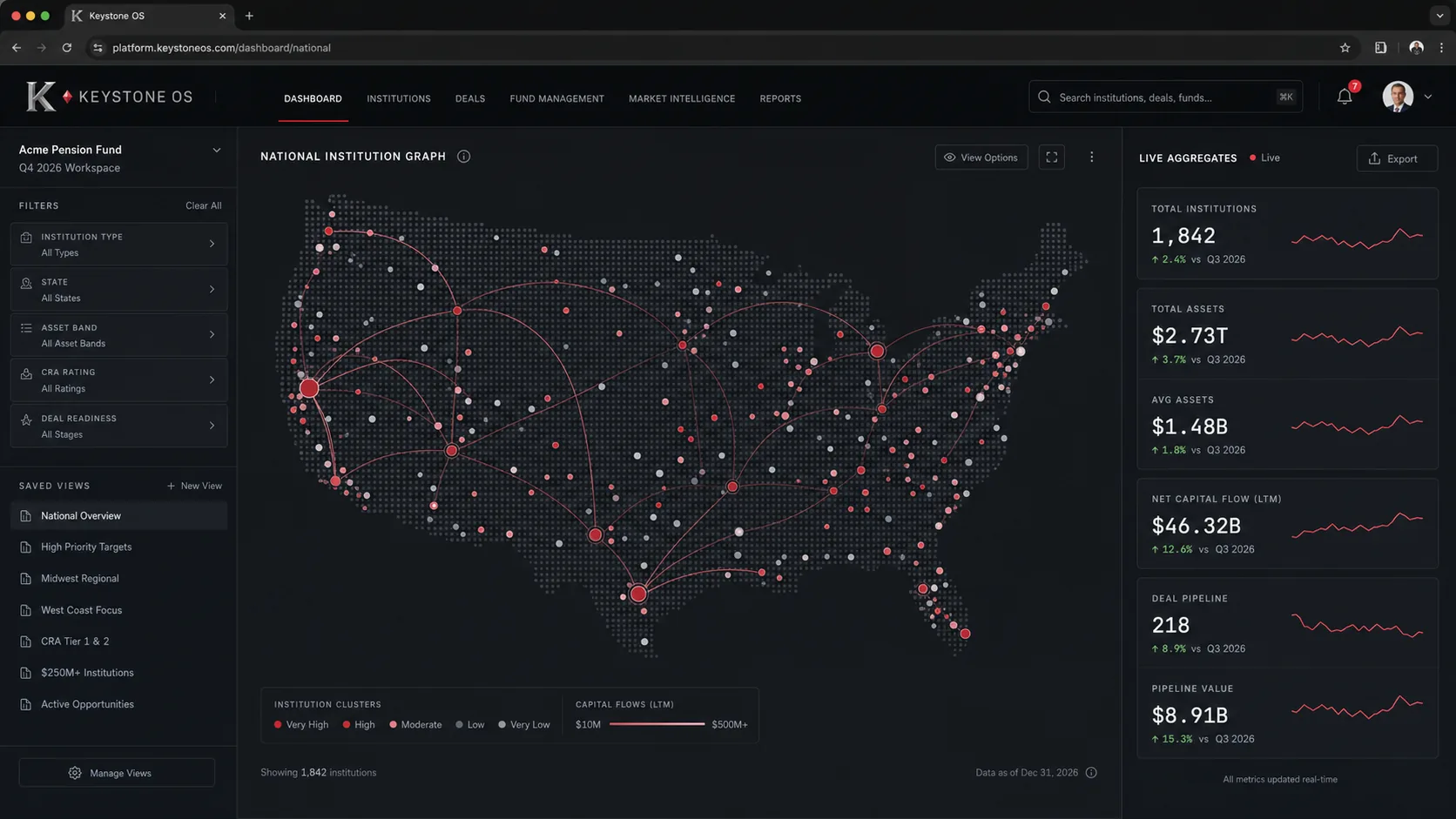
National Dashboard
Every community institution in one map. Every loan tape in one schema.
The entry point for issuers, investors, and analysts. The U.S. map renders 6,000+ institutions as nodes, colored by type and sized by total assets. Filters surface peer sets; a live aggregate panel surfaces normalized loan volume, pool composition time, and deals in flight.
Issuer filters to a peer set, identifies five candidate co-pool partners, and exports a starter pool definition into the Pool Composer.
No competitor has a national institution graph. The data network effect compounds from day one.
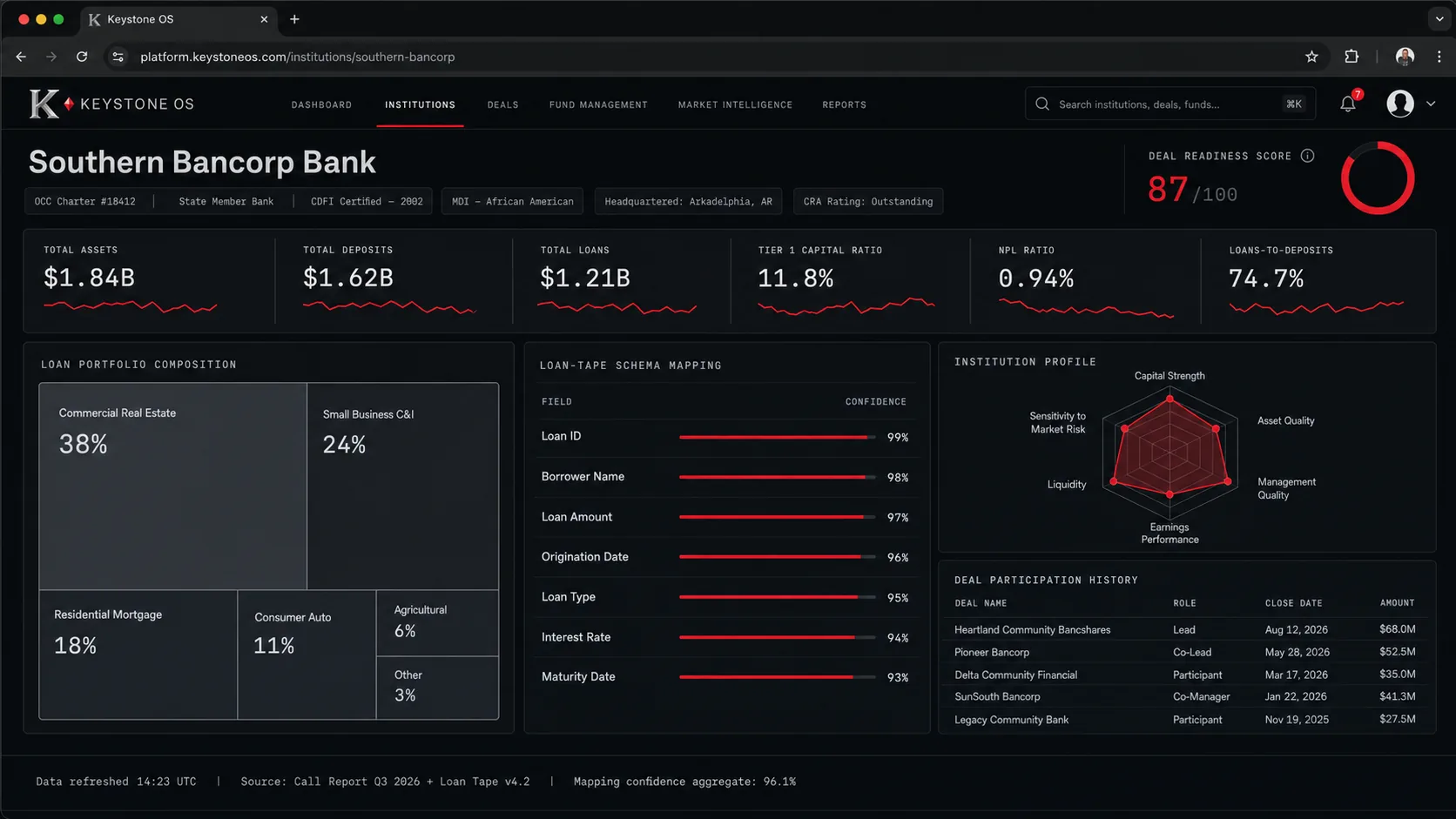
Institution Profile
Every bank, MDI, and CDFI, modeled as a first-class object.
The canonical view of one institution: charter, regulator, assets, capital ratios, CRA rating, and certification status, plus a loan-tape preview mapped into Keystone's canonical schema with a confidence score per field.
Analyst reviews schema mapping confidence, approves low-confidence flags raised by the AI, and signs the institution off as deal-ready.
This is the moat. Once an institution is mapped, it stays mapped, every addition multiplies the value of the graph.
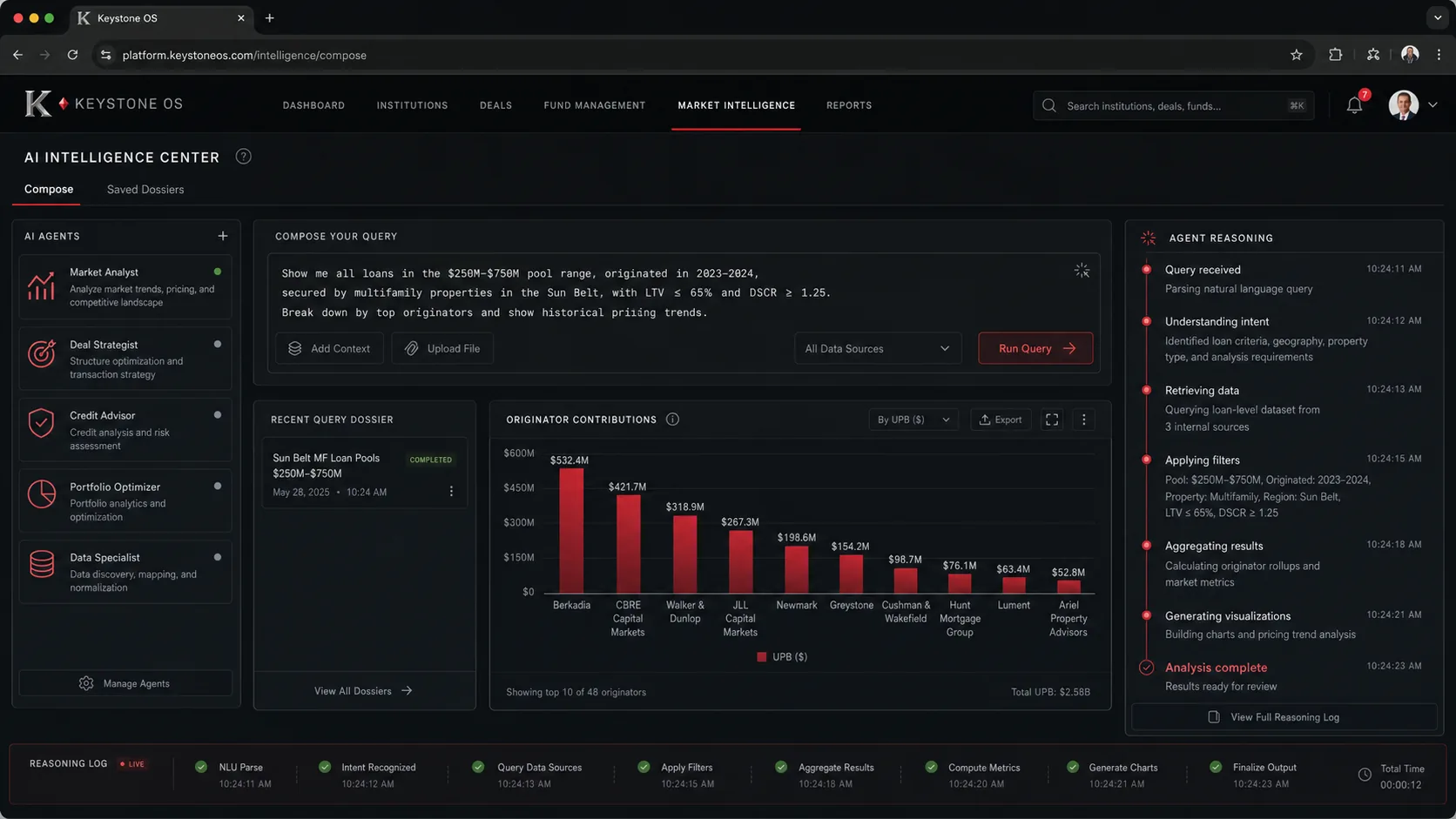
AI Intelligence Center
Six agents. One coordinator. End-to-end deal composition.
The operator's console. A horizontal agent rail shows Originate, Underwrite, Pool, Structure, Place, and Reinvest with live status. A natural-language query bar drives a workspace canvas; the right rail streams SHAP-style reasoning traces in real time.
Operator requests a $50M auto-loan pool from Southeast CDFI originators with no single-bank concentration above 20%. Agents return a candidate pool in under 60 seconds.
The category nobody else has built: AI-native securitization at the community bank tier.
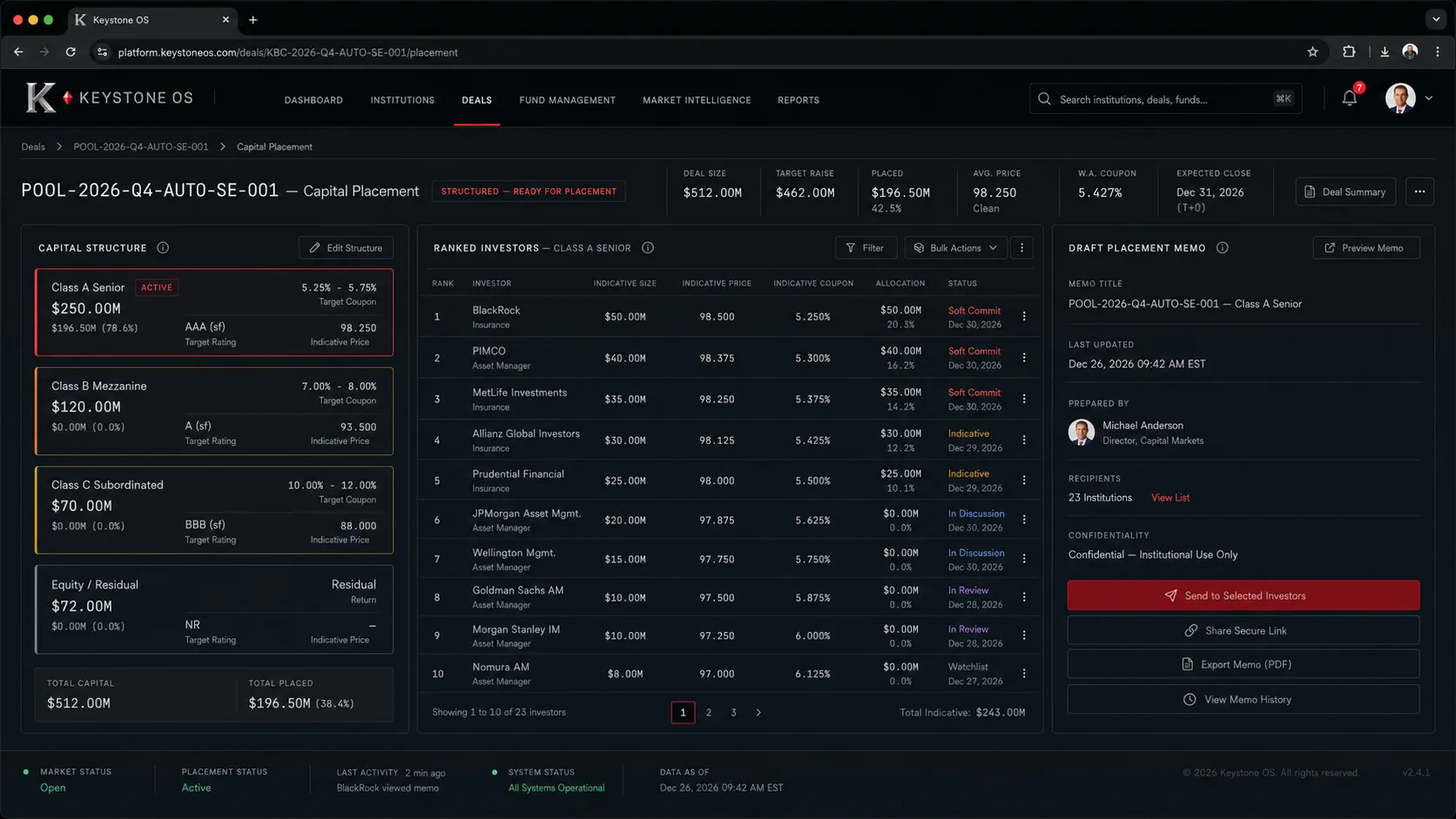
Capital Match Engine
Match every tranche to its right investor.
Sits between Structure and Place. Once a tranche stack exists, the engine ranks every CRA-motivated bank, pension, insurance, and impact fund against tranche characteristics, then drafts a placement memo for the top match.
Operator picks Tranche A, sees the top 12 ranked investors, selects three to approach, triggers draft placement memos, and sends.
The CRA Modernization Rule created the demand. This is the engine that routes it.
Impact Reporting
Every dollar attributed. Every beneficiary measured.
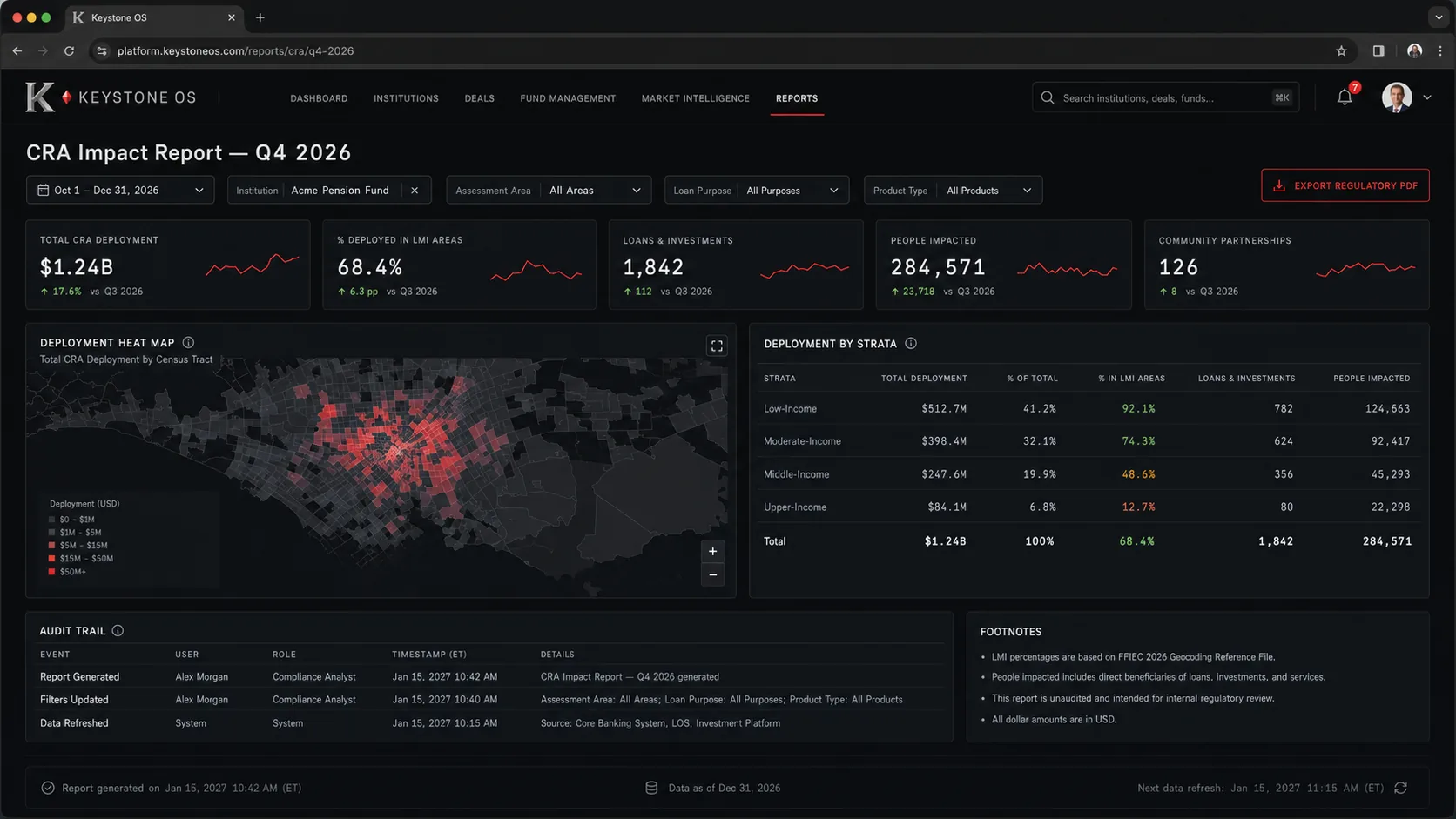
Closes the loop. Every underlying loan carries originator type, geography, demographic indicators, and sector. Deployment renders by state, by census-tract LMI status, and by borrower type, in regulatory format.
A reporting officer pulls the Q3 CRA report; it renders in under five seconds with a full audit trail.
Without impact attribution there is no CRA premium. Without the CRA premium the asset class never breaks out.
Six agents. One trust. One bond.
Originate
Ingests and normalizes loan tapes across bank cores
Underwrite
Scores loan-level eligibility with traceable attribution
Pool
Composes multi-seller pools to target concentration limits
Structure
Builds the tranche waterfall and credit enhancement
Place
Matches tranches to mandate-aligned investors
Reinvest
Recycles freed capacity back to originators
From data to growth in three steps
Connect your data
Securely link your core, loan, and portfolio systems in days, no rip-and-replace. Your data stays encrypted and never trains foundation models.
Deploy AI workflows
Turn on purpose-built workflows for underwriting, compliance, and member service. Every output is explainable and leaves an audit trail.
Grow with confidence
Move faster, serve more borrowers, and defend every decision in an exam, with a human always in the loop.
Two waves converged in 2024. The window opened.
Nine dumbbells started it all.

Eli Fields is a professional football player who just won the championship in the LFA league. When he isn't on the field, he's building the fintech that lets small community banks compete on the same footing as the giants.
It started when he transferred from Florida Atlantic University to the HBCU Southern University. At FAU, the football program had its own facility, the latest, state-of-the-art everything. At Southern, every sports team on campus shared one facility. Between all of them, there were nine dumbbells. And no one seemed concerned.
What was unthinkable at FAU had become quietly, surprisingly "normal" at Southern. That gap (same talent, same drive, radically different resources) is the thing Eli couldn't unsee.
Then he realized the exact same story was playing out in banking. Small and underserved communities were being served by institutions forced to compete without the tools the big banks take for granted. Nine dumbbells, all over again.
That's when Keystone OS was born, to give community banks, MDIs, and CDFIs the infrastructure to finally play on a level field.
Built for the regulated environment from day one.
Role-based access control with audit logging on every state change
End-to-end encryption, TLS 1.3 in transit, AES-256 at rest
Immutable audit trails on every loan-level decision
SHAP-traceable underwriting decisions for rating agency review
SOC 2 Type II compliance pathway scoped, in progress
True-sale opinion architecture for SPV formation
Public phase status.
Research complete
Architecture documented, evidence base assembled
Pilot partners
MDI/CDFI letters of intent
Regulatory alignment
Rating agency pre-engagement, SPV structure validation
Prototype
Schema mapper, underwriting agent, pool optimizer
Beta
First synthetic deal end-to-end on real anonymized data
National launch
First rated deal closes (target 2027)
The institutions agree.
Every claim Keystone makes is backed by a third-party source, federal, academic, or industry. Each quote links directly to the primary document where it was stated.
Trusted by community finance leaders
“Keystone OS gave our lending team the kind of intelligence we thought was reserved for the money-center banks, without asking us to compromise on the relationships that define us.”
Let's build the future of community capital.
Register your interest
Keystone OS is still being built. This form is not a contract and carries no obligation. It simply says you want to learn more and are willing to sign a non-binding Letter of Intent stating you believe Keystone OS would benefit your organization once it is complete. We respond to every qualified inquiry within 72 hours.
Frequently Asked Questions
Everything you need to know about bringing vertical AI to your community bank, CDFI, MDI, or credit union.
Still have questions?
Talk to our team and we'll walk you through exactly how Keystone OS fits your institution.
Talk to our teamKeystone OS is a vertical AI platform purpose-built for the community financial sector. It brings modern intelligence (underwriting support, portfolio insight, compliance workflows, and member-facing automation) into one operating system, so mission-driven institutions can move as fast as the largest banks without abandoning what makes them different.
Bring enterprise-grade AI to your institution.
Purpose-built, secure, and examiner-ready, Keystone OS helps community lenders move as fast as the biggest banks.